CATEGORIES
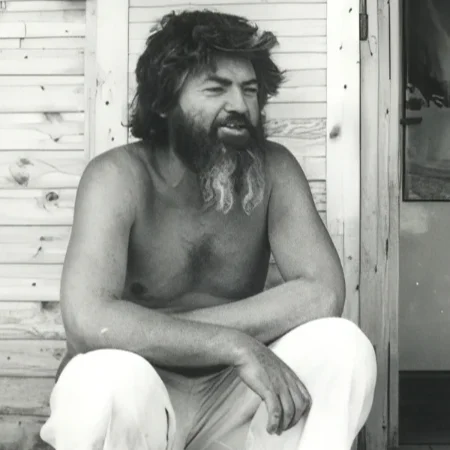
Gyula Bocz, born in Pécs in 1937 and deceased there in 2003, belongs to that small number of sculptors who did not graduate from the Hungarian University of Fine Arts yet created a remarkable body of work, but who are relatively unknown due to the specific progression of their career or other reasons.
He learned his art through autodidactic methods, initially working as a factory laborer.
While working at the Nagyharsány Sculpture Park for years, he received significant recognition, but in 1975, his activities there became impossible. Subsequently, he received no state commissions and could not hold exhibitions for ten years. In a sense, he remains an isolated phenomenon to this day. National critics truly noticed his work only in connection with the Egy/kor (One/Time) exhibition at the Műcsarnok in 2017. However, the domestic and international roots of his art are largely unexplored, and a comprehensive evaluation of his work is missing.
Bizonyos értelemben máig elszigetelt jelenség maradt.
Műveire az országos kritika a 2017-es Egy/kor című Műcsarnok-beli kiállítás kapcsán figyelt fel igazán, művészetének hazai és nemzetközi gyökerei azonban jórészt feltáratlanok, átfogó értékelése hiányzik.
One reason for this is Bocz’s reclusive rural lifestyle, as well as the fact that his oeuvre is rarely associated with artist groups; he consistently followed his own, self-governing path.
Bocz is a distinguished representative of the neo-avant-garde, particularly organic tendencies within it, and simultaneously one of the first Hungarian sculptors of land art. In 1968, in the Pintér Garden (Pintér Arboretum) in Pécs, he carved small-sized sculptures from stones found on the site, and then created a relief on the wall of a cellar beneath the city. He abandoned his four-part composition titled Life (Élet), which he carved out of the rock face of the eastern quarry of Szársomlyó at the Nagyharsány Sculpture Park between 1969 and 1972, due to work on the monumental Spiral (Spirál, 1971–1973), which is still considered his main work. During his four-decade-long career, he created more than twenty public statues and reliefs, the majority of which are located in Baranya County. He often intended his graphic works and small plastics as preliminary studies for his large-scale sculptures; monumental sculpture represented a kind of fulfillment for him.
Bocz’s favorite materials were various precious stones. Two-thirds of his works were carved from these, one-third from wood, and he also has a few pieces made of metal, bone, and glass. He primarily sourced the stones from Hungarian quarries, but also used white marble from Transylvania, Siberia, and Carrara. Friends who traveled abroad often brought him special stones. He considered his primary goal to be the revelation of the material's internal properties and the artistry inherent within them. He did not want to assign specific meaning or significance to his sculptures – he trusted in the effect the works would have on the contemporary viewer. Following his early figurative sculptures in the 1960s (e.g., Ferenc Liszt), he mainly created abstract works evoking natural forms (e.g., Wave, Spiral), though he often concealed figurative motifs in the details of his sculptures and reliefs.